
 Events
  Resources
  News
News News
Read our latest news, stories and articles

Swiss Arbitration Interview Series: ASA below 40 Co-Chairs
In Focus – ASA below 40
Denise Junior Cartier, The Barrister Group, Cartier Mediation
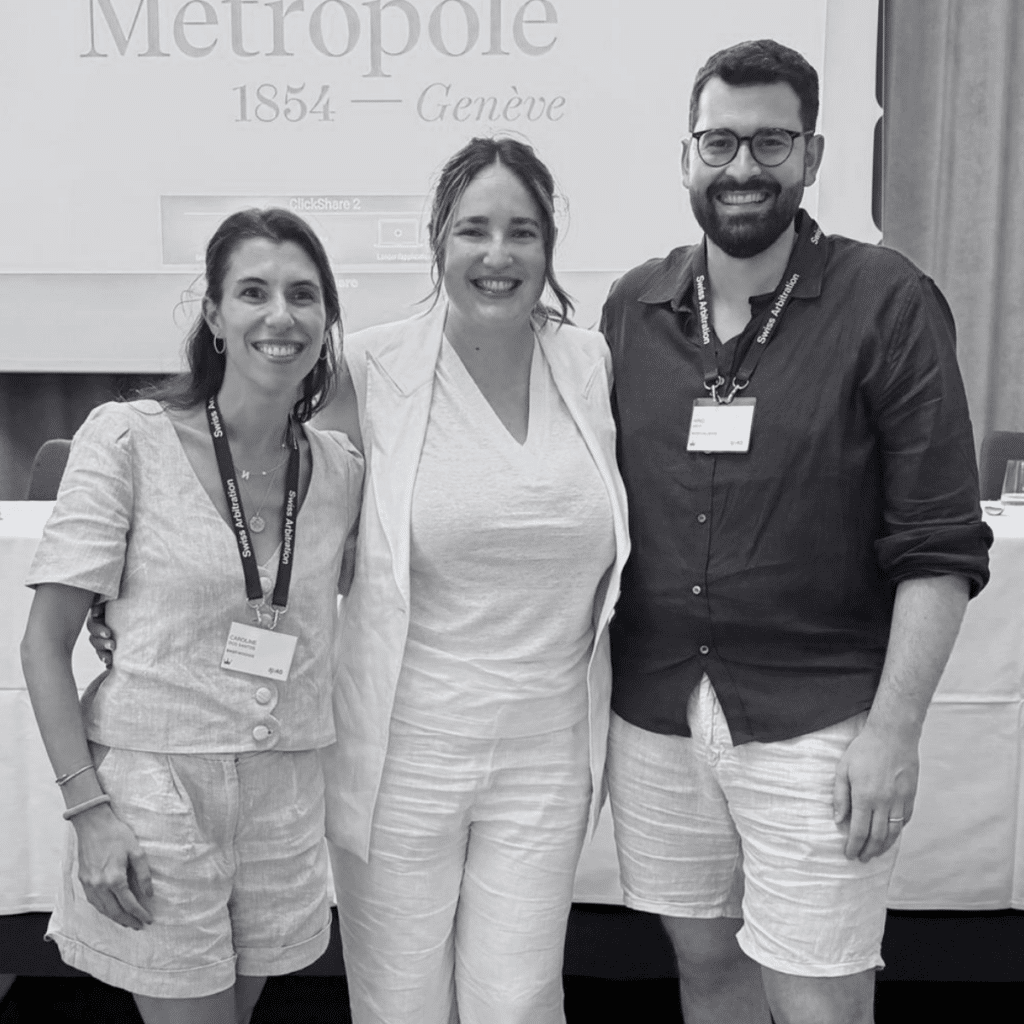
What inspired each of you to step up and become a co-chair of ASA below 40, especially on top of your demanding practices?
Caroline: I first discovered ASA below 40 back in 2017 through colleagues, and I have stayed closely connected to it ever since. I was consistently drawn to the quality of the events, the topics covered, and the overall level of organisation, which made it a natural forum to remain involved in. The community aspect also played an important role. Through various events, I built a strong network and connected with many peers over time – many of whom became friends over the years. Inspired by the trajectories of former and current co-chairs – very impressive while remaining approachable and engaged practitioners – I stepped forward to contribute more actively when the opportunity arose. I was glad it worked out and see it as a way to try to give back to a community I value a lot.
Nadja: I went to my first ASA below 40 event during my trainee year – before I was even qualified – and was immediately hooked. Not just by the substance (which was great), but by the people: a very enthusiastic group of arbitration nerds I actually enjoyed being around. I kept attending while I was working in Zurich and always had the same experience – I’d learn something and have a genuinely good time, which feels like a minor miracle for any professional event. When I moved to London, I knew I wanted to stay involved, so when the call for international co-chair came out, I jumped at it. Partly because I care about the community – but also because I operate under the persistent delusion that my day contains far more hours than it actually does and I can definitely do everything, everywhere, all at once. Being selected was genuinely exciting, and that excitement hasn’t worn off over the past three years.
Nino: I started attending ASA below 40 events even before I qualified as a lawyer, and I was struck early on by how welcoming the community was, giving me the chance to meet fantastic people. Many of those connections have stayed with me since. Stepping up as co-chair felt like a natural way to give back to a community that gave me so much at the very start of my career, and to help create that same experience for the next group of people coming through.
You each represent different hubs – Zurich, Geneva, and London. How do your distinct locations shape the global strategy and mandate of ASA below 40?
Nadja: One of my main goals during my mandate was to keep broadening the international reach of ASA below 40, while still staying true to its Swiss roots. Being Swiss and having worked in Switzerland before moving to New York and then London helped me do that – both in terms of the speakers we invited and the audiences we reached.
However, the bigger point is really structural: having co-chairs based in Zurich, Geneva, and outside Switzerland ensures precisely that we each bring different networks, perspectives, and instincts about what resonates. We’re naturally plugged into several arbitration hubs, and can pull in people, ideas, and energy from across jurisdictions. In practice, that translates into a much more diverse mix of speakers and attendees, and a program that feels genuinely international. As for how that works day to day – let’s just say that, despite my best efforts to be the international one, I remain very much a Zurich girl at heart, which means Caroline has had to endure a steady stream of good-natured (and, I maintain, entirely accurate) Geneva-bashing from Nino and me.
Young lawyers are often advised to ‘network,’ but this can feel transactional. How does the community culture of ASA below 40 foster genuine peer relationships instead of merely swapping business cards?
Nino: The difference comes down to repetition and low stakes. Swapping business cards at a one-off event is transactional because there’s no genuine follow-up. What ASA below 40 does differently is bring the same people back together across formats and over years – conferences, smaller seminars, social settings – at an early stage in everyone’s career. You meet people as peers before you meet them as opposing counsel or arbitrators. Those relationships form naturally, the way friendships do, because the pressure to extract something isn’t there. The network is a byproduct of genuine connection, not the goal of it.
Can you share a concrete example – either from your own career or a member’s – where a connection made within ASA below 40 directly unlocked a professional opportunity, a career pivot, or a referral?
Caroline: A concrete example comes to mind. A colleague was invited to speak at one of our events, which was attended by some members of an arbitral institution. She delivered an excellent contribution, and the discussions continued informally afterwards, including with some of those representatives. A few weeks later, her name was put forward by that institution for a first appointment. She has always felt that the event provided the visibility and connection that made that step possible!
Nadja: One of my favourite examples is from a Fall Seminar we organised in Zurich on arbitration across different jurisdictions. During the after-party, I got a text from a U.S. tax lawyer friend: “Random – but do you know any arbitration counsel in Finland?” At that exact moment, I happened to be sitting next to a Finnish arbitration lawyer from one of our panels. I made the introduction on the spot – and she ended up being hired as co-counsel. It was a perfect illustration of what ASA Below 40 does at its best: turning what could have been a long referral chain into a two-minute conversation over a drink.
Since you each started your tenure as co-chairs, what is the single most disruptive or sudden market shift you’ve watched younger practitioners have to navigate within the international arbitration field?
Nino: AI is the obvious answer. When my term as co-chair started, generative AI existed but was still treated with curiosity and a fair amount of caution – something people experimented with rather than relied on. In a remarkably short time, it has become a baseline expectation. For younger practitioners, that’s actually an advantage: we’re learning the craft and the technology at the same time, rather than having to retrofit one onto the other.
Historically, big international firms won mandates because they had an army of associates to throw at document production. Do you think AI acts as an equaliser, allowing boutique firms or younger, leaner teams to take on big, high-stakes disputes?
Nadja: Speaking entirely without bias as someone at a big international firm, I do think the premise is slightly overstated. Large firms haven’t just been winning mandates because they can throw bodies at a case – if anything, sophisticated clients today are very focused on lean staffing and actively push back on over-resourcing through billing guidelines.
More broadly, clients tend to prioritise quality, experience, and the right team for the dispute, rather than sheer scale. That said, I do think AI is starting to shift the conversation. It lowers the cost of certain labour-intensive tasks, making it easier for smaller or more specialised teams to compete on very large matters. However, I don’t think it’s a complete equaliser – because running a high-stakes arbitration still involves judgment, strategy, and coordination at a level that isn’t easily automated. So if anything, AI may narrow the gap at the margins – but ultimately, I think mandates will continue to be won by whoever brings the best combination of expertise, efficiency, and credibility to the table.
Speaking of AI, where do you stand on the debate over whether it is a valuable shortcut for young associates or a threat to how they build foundational legal skills and progress their careers?
Nino: I think the honest answer is that it’s both, but I’d lean toward caution. There are no shortcuts to actually knowing the record. Without that command of the facts and documents, you’re in no position to supervise an AI’s output at all. The best ideas also tend to come when you’re deep in the work: the argument you hadn’t anticipated, the inconsistency that only surfaces once you’re immersed in the materials. AI doesn’t hand you those. There’s also automation bias – the pull to over-trust a polished output and stop questioning it, which is costly in our field. None of this means AI has no place; it’s genuinely useful for certain tasks. But I’d caution young associates against relying on it too heavily, because the foundational skills it seems to save you from are exactly the ones the rest of your career is built on.
With international commercial courts rising in prominence, some see them as a direct threat to the arbitration market due to their lower costs and aggressive targeting of cross-border business disputes. Do you think these courts will make it harder for younger practitioners to sell the future value of arbitration to corporate clients?
Caroline: The development of international commercial courts certainly adds a layer to the dispute resolution landscape. Their cost-efficiency and active positioning for cross-border disputes make them well-positioned to compete with arbitration, as clients are increasingly focused on speed, cost, and accessibility. That said, arbitration retains key strengths that remain highly compelling, notably the global enforceability of awards, as well as specialisation, procedural flexibility, neutrality, and the possibility for parties to agree on the language of the proceedings. These features continue to be decisive for international businesses and ensure that arbitration remains highly relevant.
Then again, the rise of international commercial courts can also bring useful perspectives. For instance, some Swiss German courts have successfully integrated settlement hearings in the early stage of proceedings, which are very frequently successful. This settlement-oriented approach is a constructive development that arbitration practitioners – including the younger generation – can draw from to strengthen attractiveness.
If you look back to the day you first entered the field, what stands out as a challenge – or an opportunity – that is completely unique to under-40 lawyers today? How would you advise them to play it to their advantage?
Caroline: In my opinion, one notable shift in the last decade has been the increasing willingness of institutions to give first appointments to younger practitioners, alongside a stronger focus on diversity. These opportunities, however, do not come automatically. Younger practitioners still need to make themselves visible through their work, community involvement, and consistent engagement. In other words, the opportunity is clearly there, but it needs to be actively leveraged – staying engaged, contributing, and making one’s work visible can make a difference.
ASA below 40 recently hosted the 6th Global Co-chairs’ Circle Conference (CCC26) in Zurich, focusing on ‘Advocacy in a Brave New World’. Beyond technical legal knowledge, what are the essential non-technical skills the next generation must master to remain effective advocates?
Nino: Three stand out. First, judgment about technology: knowing when to use AI and, more importantly, when not to trust it, because credibility with a tribunal is destroyed instantly by an unchecked error. Second, genuine advocacy as persuasion: as the technical groundwork becomes more automatable, the human ability to read a room, tell a compelling story, and adapt in real time becomes the differentiator. Third, cultural fluency and emotional intelligence: arbitration is cross-border by nature, and the advocate who can navigate different legal cultures, expectations, and communication styles has an edge.
Securing that first arbitrator appointment is notoriously the hardest hurdle for younger practitioners. How is ASA below 40 actively helping members bridge the gap from counsel to arbitrator?
Nadja: I think Caroline already gave a very good example where the exposure someone got from speaking at one of our events actually led to an institutional appointment. Often, it is less linear than that, but ASA below 40 provides young practitioners with a first platform to secure a speaking engagement and/or actively participate in discussions, which allows members to gain visibility in the community. We have also hosted events discussing the question of how to unlock a first appointment, featuring institutional representatives, counsel and arbitrators, to share insights and strategies. Ultimately, for me, it is the relationships and profile you build at ASA below 40 that will get you noticed for appointments, be they from institutions or from colleagues.
International arbitration is inherently cross-border. How do the connections built within ASA below 40 help younger practitioners navigate differing legal cultures and expectations when working on global panels?
Nadja: Especially now, where the community has grown more international, and we regularly have events spotlighting particular jurisdictions and/or organise events abroad, often in partnership with local below 40 organisations, there is so much opportunity to build a truly international network through ASA below 40. Having those connections is invaluable as you grow in your career, for advice, for referrals, for restaurant recommendations in far-flung locations…
If you could give one piece of counterintuitive advice to a 25-year-old associate who wants to specialise in international arbitration, what would it be?
Nino: Don’t over-specialise too early. The counterintuitive move is to resist the urge to brand yourself as “the arbitration person” from day one. It pays first to simply become a good lawyer, with solid grounding in contract law, a particular industry or a second legal system. Litigation is also an excellent starting point because it trains very similar skills: fact-finding, negotiation, and storytelling, all of which are at the heart of good advocacy. Specialisation is more valuable when it sits on top of that breadth.
What do you hope your collective legacy will be as co-chairs, and what is your primary goal for the group as you look toward the next couple of years?
Caroline: A strong international community. If, years from now, people can trace a mentorship, friendship, tribunal appointment or even a career opportunity back to an ASA below 40 event, we will have succeeded!
Nadja, your three-year term as International Co-Chair sadly wraps up this summer at the Geneva Spring Seminar. Looking back, what has been your proudest moment?
Nadja: Hard to believe the 3 years are already over – it’s been a whirlwind! It’s hard for me to single out one specific moment. I am very proud of how truly international ASA below 40 has become and how we’ve deepened ties with other below 40 organisations. Pulling off the CCC2026 with over 200 participants from 21 jurisdictions (and somehow having no one go overboard on a boat tour of Lake Zurich in the process) will always be a highlight. However, I actually think it’s the quiet moments – it’s the very kind members who have come up to me to say how much they loved an event, or how they felt comfortable and at ease even though networking is hard for them; it’s the connection with my fellow co-chairs (both past and current) and the truly excellent teamwork; and the quality of the programming that has actually left attendees with some new or deeper knowledge on a wide range of arbitration topics.